TL;DR: Slab leaks in South Florida run silently for months under concrete floors, but six warning signs reveal them before reconstruction becomes the only option.
A slab leak is a water leak inside the pressurized supply lines or drain lines running beneath the concrete foundation of your home. In South Florida, slab leaks happen at a higher rate than in most other parts of the country because the combination of corrosive groundwater chemistry, aging copper plumbing in homes built before the 1990s, post-tension cable systems in many newer constructions, and a near-constant high water table accelerates pipe failure in ways drier climates rarely see. The leaks almost never announce themselves. Water seeps laterally through the slab, soaks subflooring and drywall, and creates conditions for mold growth long before anyone notices a visible stain. Homeowners who recognize the early signals catch the leak while it is still a targeted spot-repair. Those who miss them often end up paying for floor demolition, a full pipe reroute, and structural drying months later.
Why South Florida Has More Slab Leaks Than Other Regions
Three local conditions make slab leaks unusually common in Palm Beach County, Broward, and the rest of South Florida. The first is groundwater chemistry. South Florida sits on porous limestone aquifers, and the dissolved minerals in the soil, combined with the salt-influenced coastal atmosphere, create an environment that corrodes copper supply lines from the outside in. A pinhole leak on a thirty-year-old copper line is not unusual, and once one pinhole forms, more typically follow on the same run.
The second is construction era. A large share of the housing stock in Boca Raton, Delray Beach, Palm Beach, Boynton Beach, and surrounding communities was built between the 1970s and early 1990s with copper supply lines embedded in the slab. That plumbing is now reaching the age where corrosion failures accelerate. Newer homes use PEX or other modern materials and are less affected, but the older inventory is exactly the inventory most snowbirds, second-home owners, and long-term residents occupy.
The third is the water table. South Florida’s high water table keeps the soil under the slab consistently moist, which means a small supply-line leak does not drain away. It saturates the soil under the slab and pushes water upward into the slab and the wall plates through capillary action. That is why leaks under slabs in this region produce damage faster than the same leak in a drier western state.

The Six Warning Signs Homeowners Miss
1. A Water Bill That Climbed Without an Obvious Reason
Look at twelve months of water bills side by side. A slab leak running quietly for weeks will show up as a gradual climb in usage even when nothing in your household routine changed. A jump of fifteen percent or more, with no irrigation changes, no new occupants, and no pool refills, is a strong signal worth investigating.
2. The Sound of Running Water When Everything Is Off
Walk through the house at a quiet hour with every faucet closed, every appliance off, and the irrigation system disabled. Stand still near interior walls and listen. A faint hiss or trickle that you can hear with no fixture open often indicates a pressurized leak somewhere in the system, and slab-level leaks are common culprits in single-story Florida homes.
3. Warm Spots on a Tile or Wood Floor
A leak on a hot-water supply line under the slab will warm the floor above it. In single-story homes with tile or wood directly on the slab, the warm spot may be subtle, often a degree or two warmer than the surrounding floor. Homeowners often notice it in the morning when walking barefoot.
4. Cracks Appearing in Tile, Grout, or Baseboards
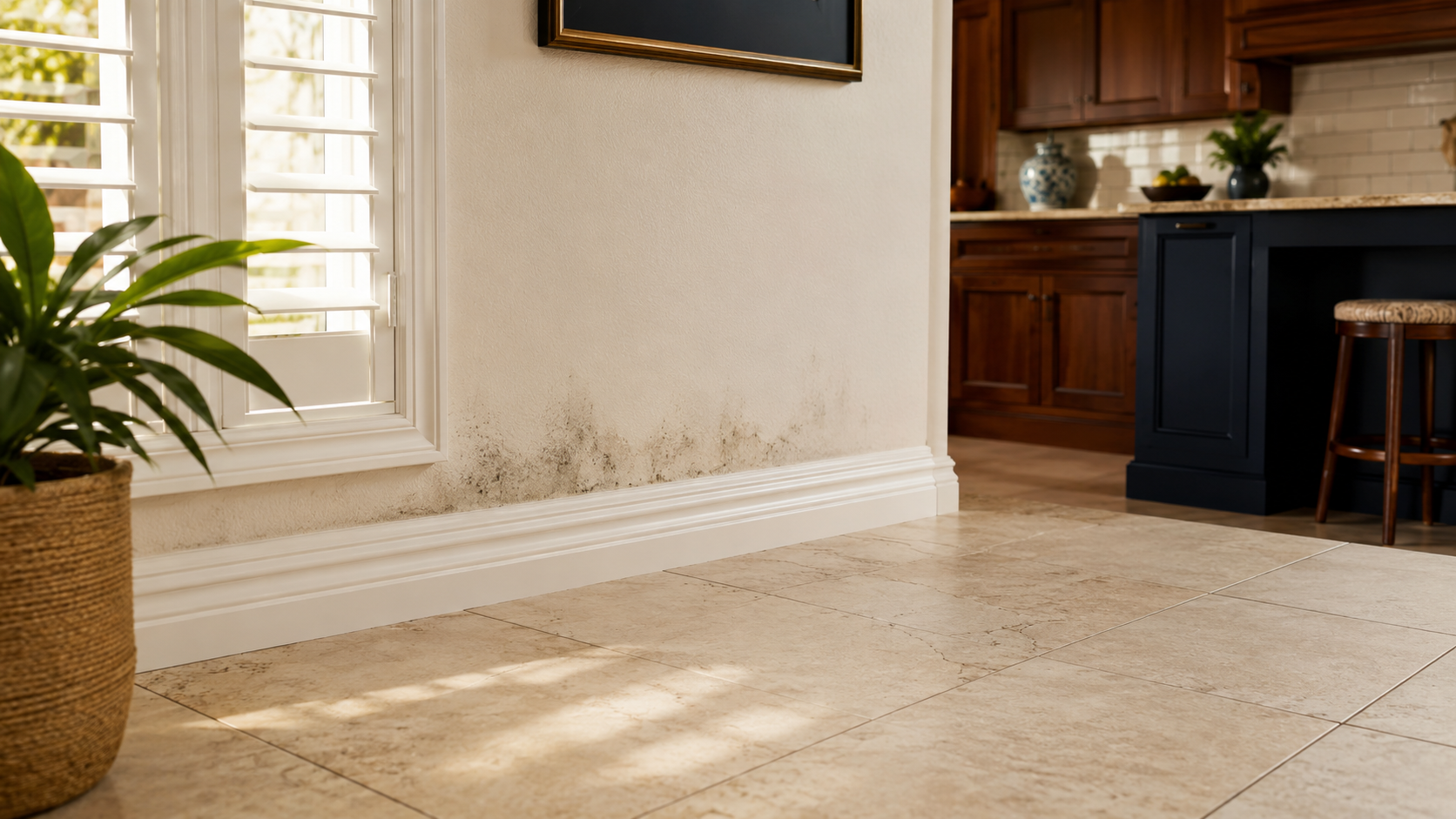
Moisture saturating the slab causes minor expansion and contraction that opens grout lines and cracks tile. Baseboards may start lifting subtly at the bottom edge as the wall plates absorb moisture. These cracks are easy to write off as settling, but a cluster of new cracks in one part of the house, especially a kitchen, bathroom, or laundry area, deserves a deeper look.
5. A Musty Smell in One Specific Room
Mold colonizes the wet underside of the slab and the bottoms of the wall plates within days of sustained moisture exposure, the point at which the work expands into mold remediation as well as plumbing repair. The smell often appears in one specific area, near a closet, under a vanity, or along an exterior wall. If you find yourself wrinkling your nose every time you enter a particular room, treat that as a leak signal, not a cleaning problem.
6. The Water Meter That Spins When Nothing Is Open
The most diagnostic of the six. Turn off every fixture and appliance in the house. Walk to the water meter and watch the small dial. If it is moving, water is leaving the system somewhere on your side of the meter. If the irrigation valve is also off and no toilet is filling, a slab leak is one of the few remaining explanations, and the next call should be to a professional who can perform hidden leak detection before any concrete is cut.
How Professionals Confirm and Locate the Leak
Detection technology has advanced significantly. A trained leak-detection technician arrives with electronic listening equipment, infrared thermal imaging, and pressure-testing tools. The listening equipment amplifies the acoustic signature of water escaping a pressurized pipe; the infrared camera maps temperature differentials across the floor that pinpoint the leak’s location under the slab; the pressure test isolates whether the leak is on the hot side, the cold side, or in the drainage lines.
The combination matters because every detection method has limits. Acoustic detection struggles in homes with thick concrete or noisy ambient environments. Thermal imaging works best on hot-water leaks. Pressure testing tells you a leak exists but not exactly where. Pairing all three pinpoints the leak to within a few inches before any concrete is cut, which is the difference between a one-day spot-repair and a multi-day demolition project. That is why hiring a leak-detection professional pays for itself before homeowners or general contractors start guessing.
The EPA’s WaterSense program estimates that household leaks waste roughly one trillion gallons of water nationally every year, and the agency’s Fix a Leak Week guidance lists slab and underground leaks among the most expensive to ignore because they cause structural and mold damage long before they show up on a water bill.

What Happens After You Confirm a Slab Leak
Once a leak is located, the homeowner has three main options. Spot repair cuts a small section of concrete directly above the leak, replaces the failed segment, and patches the floor. This is the cheapest path when only one pinhole has formed and the rest of the line is in decent shape. Reroute abandons the under-slab line entirely and runs a new supply line through walls or attic space, then connects it back into the fixture. This is the right call when the corrosion pattern suggests more leaks are coming. Repipe replaces all the affected supply lines in the home. This is the largest investment and the right call for older copper systems where systemic corrosion is documented.
Whatever the repair path, the water that already escaped the line has to be dealt with separately. Saturated slab edges, soaked drywall, and wet wall plates have to be dried, the affected materials assessed for replacement, and the area monitored for mold. The plumber fixes the pipe; emergency water removal and structural drying are what protect the house from the months of slow saturation that preceded the discovery.
When It Is Too Late for Spot Repair
The hardest conversations with homeowners happen when the leak has been silent for so long that the slab edges are saturated, multiple wall plates are soft, and visible mold has already colonized behind baseboards. At that point, spot repair fixes the leak but does not fix the building. The remediation scope expands to include drywall removal, baseboard removal, tile or wood replacement where moisture compromised the bond, controlled drying with industrial dehumidifiers and air movers, and air-quality testing in the affected zone.
The cost gap between catching a slab leak at signal two (sound of running water) versus signal six (visible mold and warped flooring) is often the difference between a four-figure repair and a five-figure project that pulls in plumbing, water damage cleanup, and structural drying together. The detection signals are the early warning system. Acting on them early is what keeps the repair small.
Frequently Asked Questions
How long can a slab leak go undetected in a South Florida home?
Weeks to months, depending on the size of the leak and the homeowner’s attention to the warning signs. Small pinhole leaks producing a few gallons per day can run quietly through an entire snowbird off-season before anyone returns to notice the consequences. The combination of high water table and moisture-trapped slab means damage accumulates faster here than in drier regions.
Can I find a slab leak myself without specialized equipment?
You can identify the warning signs and run the water-meter test yourself, which tells you whether a leak is happening. You cannot precisely locate a slab leak without acoustic detection or infrared imaging. Confirming the leak exists is the homeowner’s job. Locating it under the concrete is the leak-detection professional’s job.
Will homeowner’s insurance cover slab leak repair in Florida?
Florida policies typically cover the resulting water damage from a sudden and accidental leak, but coverage for the access work (cutting concrete to reach the pipe) and the pipe itself varies by policy. Long-term gradual leaks are often excluded. Document everything from the moment you suspect a leak and contact a professional immediately to preserve the claim.
How much does professional slab leak detection cost in South Florida?
Detection alone typically ranges from a few hundred to roughly a thousand dollars depending on home size, accessibility, and number of suspect lines. The investment is small compared to the cost of unnecessary floor demolition that happens when leaks are located by guessing.
What is the difference between a slab leak and a foundation leak?
A slab leak is a leak in the pressurized plumbing under the slab. A foundation leak is groundwater or surface water entering through cracks in the foundation itself. The signals overlap (moisture, musty smell, baseboard damage) but the source and the fix are completely different. Detection determines which one you have.
Should I shut off my water if I suspect a slab leak?
If the water-meter test confirms unaccounted usage and you cannot reach a plumber immediately, shutting off the main supply at the meter limits further damage. Use bottled or stored water in the interim. This is also the right step before leaving for an extended trip if you have ongoing suspicions.